
The BIG Programme:
Catalysing Corporate Innovation for GLCs and PLCs in Malaysia
The BIG Programme is strategically positioned to accelerate national development through the advancement of open and corporate innovation ecosystems. This transformative program serves as a dynamic catalyst, empowering corporations to transcend conventional innovation barriers - including organizational silos, resource constraints, and prohibitive R&D investments. BIG enables organizations to achieve sustainable growth while addressing evolving market demands in today's interconnected global landscape.
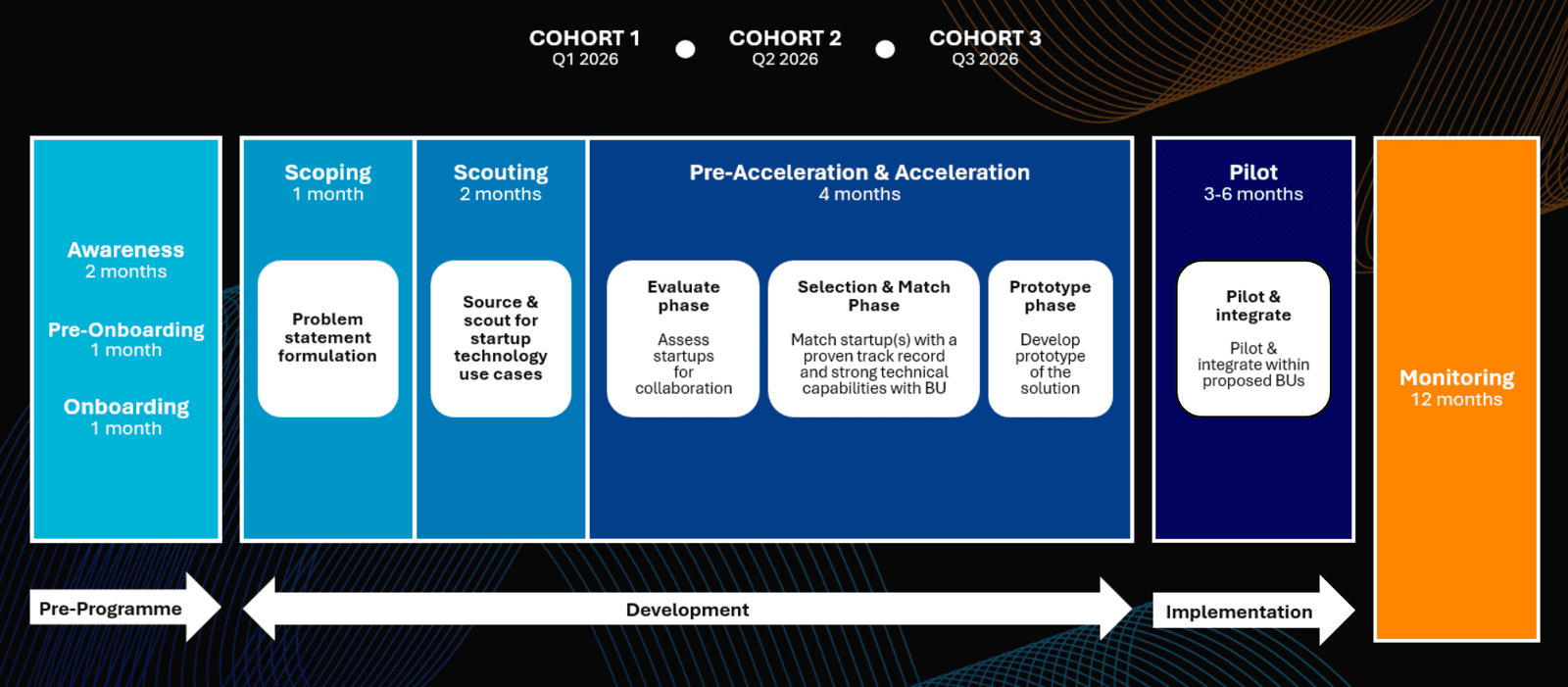
Programme Structure
Programme Timeline
WHO'S ELIGIBLE TO JOIN BIG?
Publicly Listed Corporations (PLCs)
Corporates with revenue > RM500 million
(e.g. Bursa Main Board Listed Companies)
Government-Linked Companies (GLCs)
Commercial entities where the Malaysian government holds a controlling stake
Minister of Finance (MOF) Inc. Entities
MOF Inc. owned companies with an operational revenue-generating agenda
BIG 2.0 Problem Statements

OSK Construction
Problem Statement:
Malaysia's construction industry remains heavily dependent on lagging indicators to measure project progress. While large projects generate thousands of daily operational events – including work commencements, inspections, defects and completion activities – these remain fragmented across disconnected workflows, without a common spatial context.
As a result, actual site progress remains disconnected from the Construction Master Programme. Delays are often identified only after schedule slippage has occurred. Project teams must then manually consolidate fragmented information, reassess dependencies, and prepare Catch-Up programmes. This adds significant planning time during critical phases of project recovery.
Recognising this industry-wide gap, OSKC aims to establish a continuous, location-aware Spatial Intelligence Framework that transforms daily construction activities into structured progress intelligence, enabling earlier detection of schedule risks and more proactive project recovery.

PLUS
Problem Statement:
PLUS operates Malaysia's largest highway network, and its Rest and Service Areas (RSAs) are where millions of highway users stop to rest, eat and recharge. Every day, PLUS generates large volumes of traffic, footfall, and point-of-sale data.
However, these data streams sit in separate systems, so decisions on tenant mix, promotions, and capital investment are still largely driven by intuition. At the same time, customer behaviour is changing quickly. EV drivers stay longer while charging; travellers expect café-grade food and beverage, and families, commuters and long-haul drivers each want something different from the same stop.
Without a connected view of what customers do and what they buy, slow periods go unnoticed, underperforming tenants are not addressed, and RSA upgrades risk being prioritised by perception rather than by where returns are the highest.

Solarvest
Problem Statement:
Malaysia's renewable energy capacity is forecast to nearly triple by 2031, driven by demand from data centres, industrial growth and the wider energy transition. However, solar and battery assets remain fragmented across different owners, systems and equipment brands, and no Malaysian platform yet unifies them. As a result, asset owners overpay for electricity, the grid cannot draw on these distributed sites, and surplus energy goes unshared. This gap widens every year and is now emerging across ASEAN. Malaysia therefore needs a home-grown aggregator and virtual power plant (VPP) platform before foreign players claim this strategic role.
The proposed solution is a single platform that unites distributed solar and battery assets and operates them as one coordinated system. The platform works with any equipment brand, forecasts each site's solar generation and energy consumption, and charges and discharges batteries at the most cost-effective time. It brings every site and every owner onto one screen, supported by performance and savings reports, while keeping each owner's data private and secure.
Interested in Solution Providers in the following areas:
- Energy data integration and IoT
- Solar and load forecasting
- BESS dispatch optimization
- Aggregator and VPP platforms
- Energy management and analytics software
- Battery health and asset performance
- Cybersecurity for energy and OT systems
- Energy market, tariff and settlement tools

Uzma Berhad
Problem Statement:
Malaysia's Smart Nation 2040 aspiration under the Fifth National Physical Plan (NPP5) depends on accurate and up-to-date geospatial data. However, existing AI mapping models are not sufficiently adapted to Malaysia's diverse geographical and built environments, including complex urban landscapes, rural settlements, and varied building structures.
These limitations increase manual intervention, slow mapping updates, and affect the availability of reliable geospatial data for spatial planning and Smart City initiatives. Uzma aims to develop a locally owned, Malaysian-trained geospatial AI capability that improves mapping accuracy, reduces manual effort, and supports continuous improvement.
Interested in Solution Providers in the following areas:
- Artificial Intelligence (AI)
- Geospatial & Satellite Technologies
- Temporal Data & Change Detection
- Predictive Modelling and Forecasting
- Research, Innovation & Technology Development



Telekom Malaysia
Problem Statement:
Fibre infrastructure plays a critical role in enabling reliable digital connectivity for the nation. However, external factors such as theft, vandalism, third-party excavation and construction activities, as well as pests may affect service reliability, increase operational costs and impact customer experience.
To strengthen network resilience and support more efficient management of fibre infrastructure at scale, TM is exploring innovative, data-driven solutions that can enhance network intelligence through predictive analytics, early fault detection and proactive monitoring.
Interested in Solution Providers in the following areas:
- Network Analytics
- Machine Learning
- Predictive Models
- IoT Monitoring
- Edge AI
- Fault Detection
- Smart Infrastructure
- Targeted sensing
- Geospatial intelligence
Sime UMW
Problem Statement:
Aerospace CNC machining in Malaysia relies heavily on manual prove-outs, disconnected digital tools, and conservative machining parameters, leading to higher cost, increased risk, and slower innovation.
Sime UMW aims to develop an Advanced Closed-Loop Digital Manufacturing System which integrates CNC verification, machine simulation, machining optimisation, and live machine connectivity to enable first-time-right machining and continuous learning from real machine data.
SD Guthrie
Problem Statement:
As large-scale estate operations become increasingly data-driven, there is an opportunity to integrate operational data across harvesting, labour management, asset utilisation, and overall operations.
Interested in Solution Providers in the following areas:
- Mobile-enabled field data capture
- IoT and telematics integration
- Real-time data ingestion
- AI/ML models for productivity, labour optimisation, and maintenance
- Centralised analytics dashboarding
Pioneering Corporates

























BIG Media
An Initiative By:


Powered By: